

Introduction
Demand for stainless steel light poles is rising as buyers shift from lowest upfront cost to long-term performance, especially in coastal, industrial, and high-traffic environments where corrosion and maintenance can quickly erode budgets. In 2026, the market is being shaped by infrastructure replacement cycles, stricter durability expectations, and growing interest in poles that can support lighting, sensors, and telecom equipment. This article explains the main trends influencing pricing and demand, where adoption is accelerating, and what procurement teams, contractors, and developers should compare before choosing products for public or commercial projects.
Why the 2026 Stainless Steel Light Pole Market Is Growing
The trajectory of the light pole market heading into 2026 is driven by a shift from initial-cost procurement to lifecycle-cost optimization. Municipalities, commercial developers, and transportation authorities are increasingly prioritizing resilient infrastructure capable of withstanding severe environmental stressors while supporting next-generation telecommunications hardware.
Infrastructure renewal and durability demand
Municipalities and private developers are aggressively addressing aging infrastructure grids, many of which rely on legacy carbon steel poles that have reached the end of their 30-year operational lives. As these assets suffer from advanced corrosion and structural degradation, stainless steel is emerging as the premier replacement material, offering a projected operational lifespan exceeding 50 years with minimal maintenance. Market analytics project a steady 5.8% compound annual growth rate (CAGR) for stainless steel variants through 2026, driven largely by deployments in coastal zones, heavy industrial sectors, and regions utilizing highly corrosive de-icing salts.
Key end-use segments driving adoption
Adoption is heavily concentrated in smart city developments and critical coastal transportation networks. Modern smart poles are no longer merely lighting fixtures; they serve as structural backbones for urban connectivity. Telecommunications nodes, 5G small cells, environmental sensors, and advanced surveillance cameras routinely add 50 to 150 pounds of static load to the pole assembly. This equipment also significantly increases the Effective Projected Area (EPA) wind load. Departments of Transportation (DOTs) are increasingly mandating 316L stainless steel for these high-load, high-value integrations to prevent catastrophic structural failures and protect expensive mounted electronics from wind-induced harmonic vibration.
Product Specifications and Selection Criteria

Specifying assets within the stainless steel light pole market requires a rigorous evaluation of metallurgical properties, structural geometry, and environmental exposure. Buyers must establish exact engineering baselines to prevent costly over-specification or dangerous under-specification.
How to define stainless steel light poles
Baseline definitions for these poles hinge on the specific austenitic stainless steel grades utilized, predominantly Types 304, 316, and the low-carbon 316L variant. This selection dictates the material's inherent resistance to pitting and crevice corrosion. Structurally, these poles are defined by their cross-sectional geometry (round, square, or octagonal) and wall thickness. Wall thicknesses typically range from 11-gauge (0.1196 inches) for standard pedestrian and pathway lighting to 7-gauge (0.1793 inches) or thicker for high-mast highway applications subjected to extreme dynamic loading.
Key comparison points in the market
When evaluating the light pole market, procurement engineers must benchmark stainless steel against alternative materials. The following table illustrates key structural and economic differentials:
| Material Grade | Yield Strength (psi) | Tensile Strength (psi) | Pitting Resistance Equivalent Number (PREN) | Relative Cost Index |
|---|---|---|---|---|
| Type 304 Stainless | 30,000 | 75,000 | ~18 | 1.0x |
| Type 316 Stainless | 30,000 | 75,000 | ~24 | 1.3x |
| Aluminum 6063-T6 | 25,000 | 30,000 | N/A | 0.85x |
| Galvanized Carbon Steel | 36,000 | 58,000 | N/A | 0.6x |
This comparative matrix highlights why stainless steel commands a premium: its tensile strength is substantially higher than aluminum, while its corrosion resistance outpaces galvanized steel.
Performance trade-offs in material selection
The primary trade-off in material selection centers on the strength-to-weight ratio and initial capital expenditure versus long-term maintenance requirements. While aluminum offers a lighter installation profile—reducing crane sizing and labor during erection—the 75,000 psi tensile strength of austenitic stainless steel permits significantly smaller outer diameters. This slimmer profile is highly advantageous in dense urban streetscapes where sidewalk real estate is restricted. However, the higher density of stainless steel (approximately 0.29 lbs/in³) means that shipping weights will be heavier, directly impacting logistics costs for large-scale utility deployments.
Pricing, Manufacturing, and Supply Chain Factors
Navigating the commercial landscape of the 2026 light pole market demands an understanding of volatile commodity pricing and evolving global supply chains. Procurement teams must actively manage material indices and production timelines to safeguard project budgets.
Main cost drivers for stainless steel light poles
The raw material cost of stainless steel is intrinsically linked to global nickel and molybdenum indices. Nickel, which constitutes 8% to 10% of Type 304 and 10% to 14% of Type 316 alloys, frequently accounts for up to 40% of the price volatility in finished poles. Additionally, the labor-intensive nature of Tungsten Inert Gas (TIG) and Metal Inert Gas (MIG) welding required for stainless steel fabrication introduces a high labor cost variable. Unlike carbon steel, stainless steel requires specialized shielding gases, dedicated clean-room environments to prevent cross-contamination, and slower welding travel speeds to avoid heat-induced warping.
Domestic, regional, and global sourcing models
Procurement models are bifurcating into domestic and regional nearshoring strategies. While trans-Pacific offshore sourcing traditionally offered a 15% to 20% unit cost reduction, unpredictable ocean freight rates, extended transit times, and complex tariff structures have eroded these margins. Consequently, many North American and European buyers are pivoting toward domestic manufacturers or nearshore facilities. These regional models insulate buyers from geopolitical shocks and drastically compress transit timelines, even if the baseline factory-gate price remains marginally higher.
How to reduce lead time and supply risk
Mitigating supply chain risk requires strategic engineering and procurement alignment. Standardizing base plate dimensions and bolt circle diameters (typically 10 to 14 inches for standard municipal poles) allows manufacturers to pre-stage raw materials and utilize automated plasma cutting for anchor plates. By avoiding hyper-customized tapers and proprietary luminaire tenons, buyers can compress standard 12- to 16-week lead times down to a more manageable 6 to 8 weeks. Establishing blanket purchase orders with staggered release dates further incentivizes manufacturers to secure raw steel allocations at favorable quarterly rates.
Compliance, Quality, and Risk Management
Risk mitigation in high-value infrastructure projects relies on strict adherence to structural engineering codes and rigorous quality assurance protocols. Defective fabrication in the light pole market can lead to catastrophic failures, making compliance documentation a non-negotiable procurement requirement.
Codes, certifications, and engineering documents
In North America, compliance is governed primarily by the American Association of State Highway and Transportation Officials (AASHTO) LTS-6 or LTS-7 specifications for structural supports. Engineers must calculate wind load ratings for base wind speeds ranging from 90 mph in inland zones to over 150 mph in hurricane-prone coastal regions. Documentation must include stamped structural calculations from a licensed Professional Engineer (PE), detailing the pole's deflection limits, fatigue mitigation for vortex shedding, and anchor bolt shear capacities.
How to assess weld quality and surface treatment
Quality assurance during manufacturing is predominantly focused on weld integrity and surface passivation. All welding must conform to AWS D1.6 (Structural Welding Code – Stainless Steel). Inspectors should mandate non-destructive testing (NDT), such as liquid penetrant or ultrasonic testing, on full-penetration base welds. Furthermore, mechanical polishing followed by chemical passivation—using nitric or citric acid per ASTM A380 standards—is required to strip away free iron and restore the protective chromium oxide layer. Failure to properly passivate welds will result in rapid localized rusting, entirely defeating the purpose of specifying stainless steel.
Common failure modes and warranty review
Understanding common failure modes is essential for negotiating comprehensive warranties. The most prevalent risk for austenitic stainless steel in coastal environments is chloride-induced stress corrosion cracking (SCC), which typically attacks the heat-affected zones near the base plate.
| Failure Mode | Root Cause | Inspection / Prevention Method | Typical Warranty Coverage |
|---|---|---|---|
| Weld Fatigue | Excessive EPA wind loading / vibration | Liquid Penetrant Testing (PT) / Ultrasonic Testing (UT) | 5-10 Years |
| Stress Corrosion Cracking | High chloride exposure on stressed components | Specify Type 316L / Routine freshwater washing | Excluded if improper grade specified |
| Galvanic Corrosion | Dissimilar metal contact (e.g., carbon steel bolts) | Dielectric isolation / Use of 316 SS hardware | 1-5 Years |
| Surface Tea Staining | Free iron contamination during fabrication | ASTM A380 Passivation / Visual Inspection | 1-3 Years |
Buyers must scrutinize warranty fine print, as many manufacturers will void coverage if incompatible carbon steel hardware is utilized during installation, triggering galvanic corrosion.
Final Buying Decisions for 2026
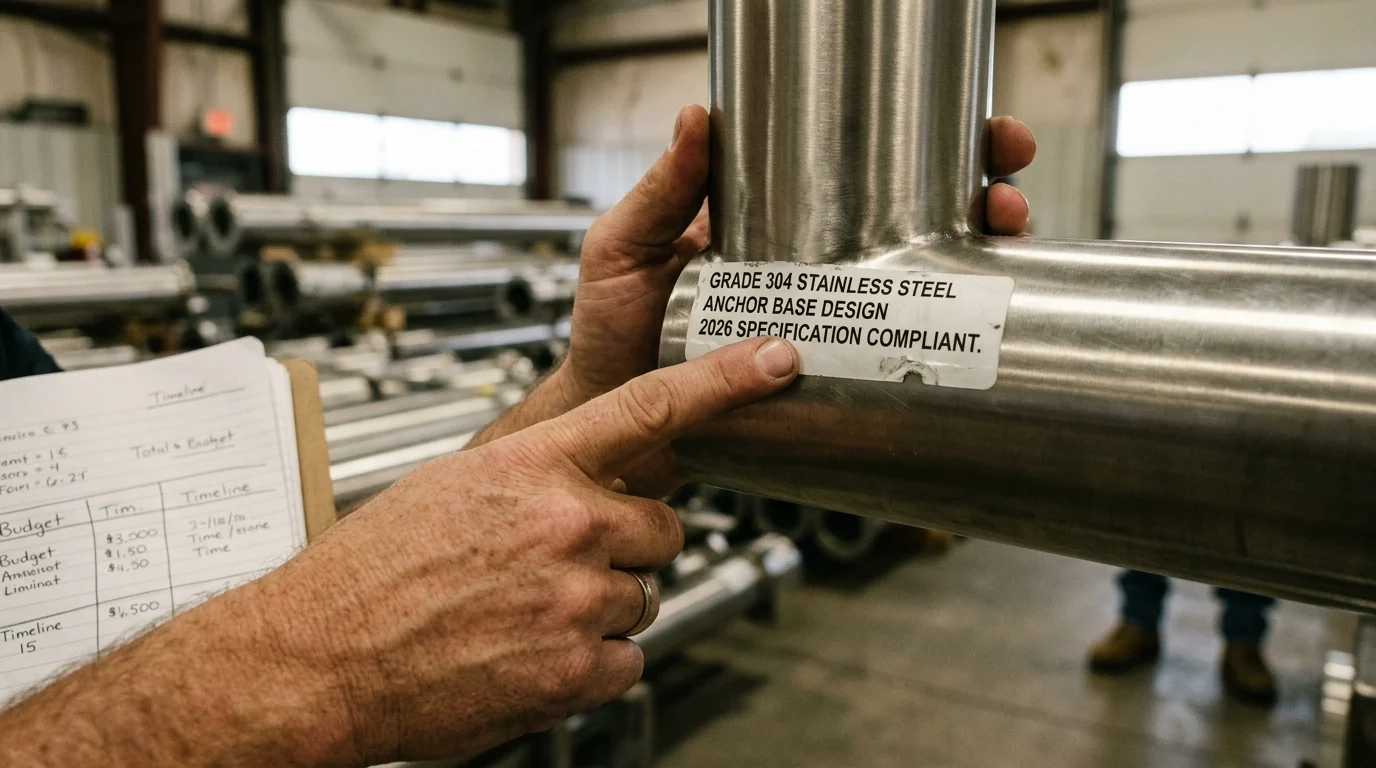
As the 2026 light pole market matures, procurement professionals must synthesize metallurgical data, supply chain logistics, and engineering specifications into actionable purchasing strategies. Final vendor selection should be driven by verifiable manufacturing maturity and long-term asset alignment.
Supplier evaluation frameworks
Robust supplier evaluation frameworks must move beyond unit pricing to assess manufacturing capacity and quality control infrastructure. Audits should verify ISO 9001 compliance, the continuous employment of in-house AWS Certified Welding Inspectors (CWIs), and the facility's ability to execute Factory Acceptance Testing (FAT). Additionally, buyers should evaluate Minimum Order Quantity (MOQ) thresholds. While large-scale manufacturers may require MOQs of 50 to 100 units to justify tooling changes, specialized boutique fabricators can accommodate batches as small as 10 to 20 units for custom architectural profiles, albeit at a 15% to 25% price premium.
How to align specifications with project goals
Ultimately, aligning specifications with project goals requires a rigorous Total Cost of Ownership (TCO) analysis. While a Type 316L stainless steel pole may require a 40% to 60% higher initial capital expenditure than a galvanized steel equivalent, the elimination of cyclical repainting, rust remediation, and premature replacement yields a positive return on investment within 12 to 15 years. For smart city deployments and critical infrastructure where pole replacement necessitates costly street closures and telecommunications downtime, this premium is easily justified. Buyers finalizing their 2026 procurement contracts must ensure that their material choices directly reflect the lifecycle demands of their specific geographic and operational environments.
Key Takeaways
- The most important conclusions and rationale for light pole market
- Specs, compliance, and risk checks worth validating before you commit
- Practical next steps and caveats readers can apply immediately
Frequently Asked Questions
Why are stainless steel light poles gaining share in 2026?
They offer 50+ year service life, low maintenance, and strong corrosion resistance, especially for coastal roads, de-icing salt zones, and smart city upgrades.
Which stainless steel grade is best for coastal or corrosive sites?
316L is typically the best choice for coastal, industrial, and salt-exposed projects because it provides stronger pitting and crevice corrosion resistance than 304.
How do stainless steel poles compare with aluminum or galvanized steel?
Stainless steel costs more upfront, but it delivers higher tensile strength than aluminum and better corrosion resistance than galvanized steel, reducing long-term maintenance and replacement risk.
What should buyers specify before requesting a quote from Morelux?
Provide pole height, mounting load, EPA/wind region, base plate or embed type, finish, project environment, and any smart equipment like cameras or 5G devices.
Can Morelux support custom stainless or mixed-material pole projects?
Yes. Morelux offers in-house cutting, bending, welding, coating, anodizing, and testing, which helps municipalities and contractors source tailored poles with controlled quality.