
Introduction
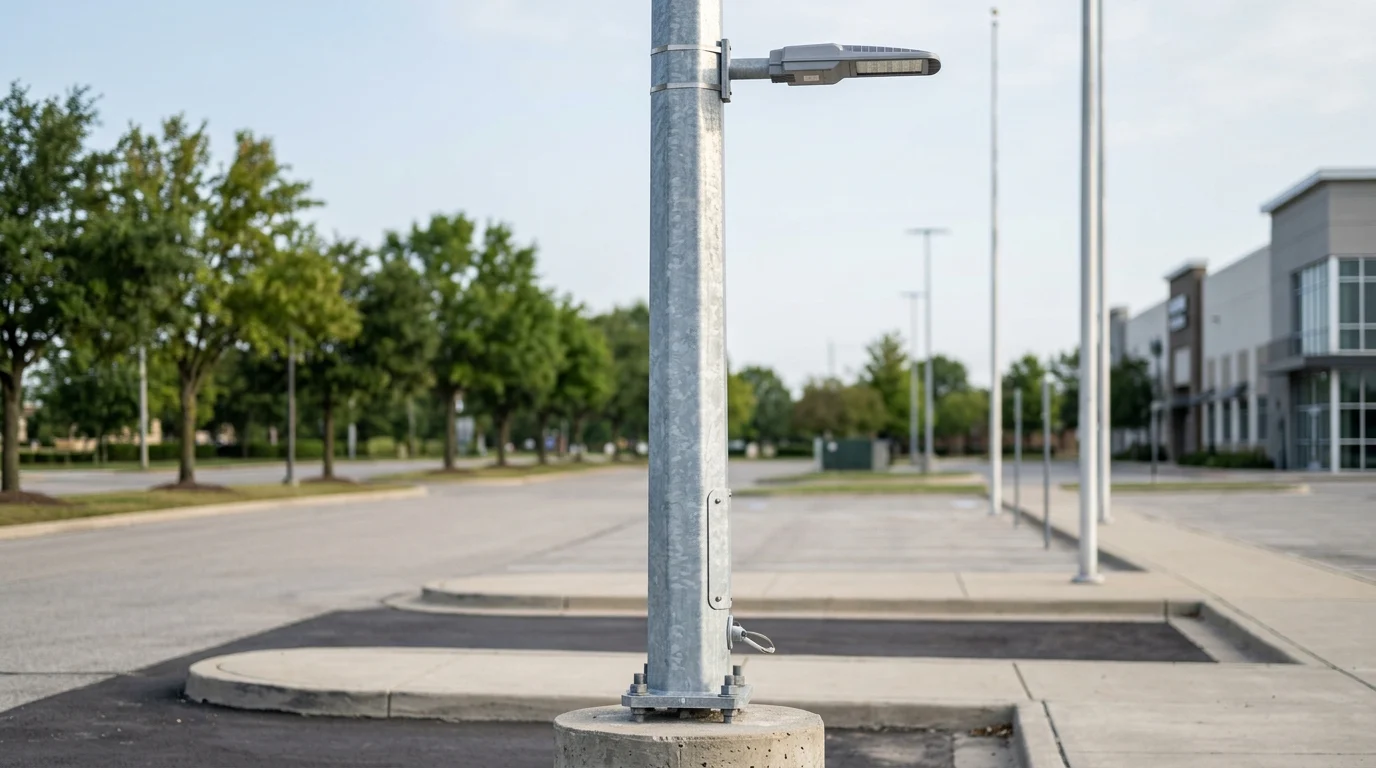
Material choice for outdoor lighting now affects far more than appearance or corrosion resistance. In 2026, steel light poles are often evaluated against aluminum in terms of structural capacity, upfront cost, maintenance needs, and readiness for added loads such as smart sensors, 5G equipment, and EV-support hardware. This comparison explains where steel typically delivers the strongest value, where aluminum may offer advantages, and how each material performs under different environmental and budget conditions. The sections that follow outline the engineering tradeoffs, lifecycle cost implications, and project-specific factors that matter most when selecting a pole for modern infrastructure.
Why Steel vs. Aluminum Light Poles Is a Strategic Choice
Selecting the correct material for outdoor lighting infrastructure requires balancing structural integrity, budget constraints, and environmental resilience. As municipalities and private developers upgrade to smart city frameworks in 2026, light poles are no longer merely carrying luminaires; they are increasingly tasked with supporting heavier payloads, including 5G small cells, environmental sensors, and electric vehicle charging nodes. This evolution places unprecedented mechanical demands on pole infrastructure.
Consequently, the debate between steel light poles and aluminum alternatives has shifted from a simple aesthetic or localized weather preference to a complex engineering and financial calculation. Specifiers must navigate a matrix of load capacities, global supply chain dynamics, and multi-decade lifecycle costs to determine the optimal material for a given installation.
Project economics, supply risk, and lifecycle expectations
The economic comparison between steel and aluminum extends far beyond the initial purchase order. Steel light poles typically offer a 30% to 40% reduction in upfront capital expenditure (CAPEX) compared to their aluminum counterparts. However, operating expenditure (OPEX) models must account for maintenance. Unprotected steel is susceptible to oxidation, requiring periodic inspection and potential recoating, whereas aluminum naturally forms a protective oxide layer, minimizing maintenance costs over a 30-year lifecycle.
Supply chain risks in 2026 also dictate material selection. The global steel market, while subject to cyclical tariff fluctuations, benefits from highly localized fabrication networks across North America and Europe. This localization often buffers large-scale infrastructure projects from extreme geopolitical volatility. Conversely, the aluminum supply chain is more energy-intensive and heavily reliant on specific international bauxite and smelting corridors, which can inject price volatility and extend lead times during energy crises.
Applications where the differences matter most
The divergence in material capabilities becomes starkly apparent in specialized applications. High-mast lighting configurations—often exceeding 30 meters (100 feet) and carrying massive LED arrays for highways or shipping ports—almost exclusively demand steel. The structural rigidity and high Effective Projected Area (EPA) capacity of steel allow it to withstand significant wind loads without catastrophic deflection.
Conversely, aluminum is frequently specified for pedestrian-scale urban environments, coastal boardwalks, and residential developments where poles rarely exceed 6 to 9 meters (20 to 30 feet). In these applications, the extreme corrosive threat of airborne salinity outweighs the need for massive structural capacity. The choice ultimately hinges on whether the project prioritizes raw structural strength to support heavy fixtures or inherent resistance to harsh, localized atmospheric conditions.
Performance Differences Between Steel and Aluminum Light Poles
The fundamental performance differences between steel and aluminum light poles are rooted in their metallurgical properties. Engineers must evaluate how each material behaves under dynamic loads, vibrations, and environmental stressors. These intrinsic properties directly influence the maximum allowable pole height, the necessary wall thickness, and the overall geometric design of the shaft.
Material properties, structural capacity, and pole design
Standard carbon steel used in light poles (such as ASTM A500 Grade B or C) boasts a minimum yield strength ranging from 42,000 to 50,000 psi. This high structural capacity allows steel poles to support substantial luminaire weights and wind loads with relatively thin wall profiles (often 11-gauge or 0.1196 inches). The inherent stiffness of steel minimizes sway, which is critical for maintaining focused beam angles in precision lighting and ensuring the stability of attached security cameras.
Aluminum alloys utilized for lighting infrastructure, predominantly 6063-T6 or 6061-T6, offer a lower minimum yield strength, typically between 25,000 and 30,000 psi. To achieve comparable structural capacity to steel, aluminum poles require significantly thicker walls (often 0.156 to 0.250 inches) and larger base diameters. While aluminum can be extruded into complex, aesthetically pleasing cross-sections, it cannot match the raw load-bearing threshold of carbon steel in heavy-duty applications.
Corrosion resistance, coatings, fatigue, and maintenance
Corrosion resistance is the most cited differentiator between the two materials. Steel is highly reactive to moisture and oxygen, necessitating robust protective systems. Hot-dip galvanizing (ASTM A123) provides a zinc barrier that sacrifices itself to protect the underlying steel, typically offering 50 to 75 years of maintenance-free life in benign environments. When combined with a factory-applied powder coat over the galvanization, steel achieves excellent weatherability, though scratches penetrating to the base metal can still initiate localized red rust.
Aluminum is inherently corrosion-resistant. When exposed to air, it immediately forms a microscopic, impermeable layer of aluminum oxide that halts further degradation. However, aluminum is uniquely vulnerable to galvanic corrosion if placed in direct contact with dissimilar metals (like steel bolts) in the presence of an electrolyte. Furthermore, aluminum lacks a distinct fatigue limit. Unlike steel, which can theoretically endure an infinite number of stress cycles below its fatigue threshold, aluminum will eventually succumb to fatigue failure after millions of wind-induced vibration cycles, making vibration dampeners essential for aluminum poles in high-wind, low-load scenarios.
Strength-to-weight, deflection, and service life at a glance
Evaluating strength-to-weight ratios reveals that aluminum is roughly one-third the weight of steel but also substantially less rigid. A standard 30-foot steel pole might weigh 300 pounds and deflect minimally under a 90 mph wind gust, whereas an identically sized aluminum pole might weigh only 120 pounds but experience visible deflection under the same load.
| Metric / Property | Carbon Steel (ASTM A500 Gr. C) | Aluminum (Alloy 6063-T6) |
|---|---|---|
| Typical Yield Strength | 46,000 – 50,000 psi | 25,000 – 30,000 psi |
| Density | ~0.284 lbs/in³ | ~0.098 lbs/in³ |
| Modulus of Elasticity | 29,000 ksi (High rigidity) | 10,000 ksi (Higher deflection) |
| Max Practical Height | 150+ feet (High-mast) | ~40 feet (Standard commercial) |
| Corrosion Mechanism | Oxidation (Requires coating) | Natural oxide passivation |
This table highlights why steel remains the dominant choice for structural efficiency. While aluminum's low density facilitates easier manual handling during installation, steel's superior modulus of elasticity ensures that heavy multi-fixture arrays remain stable, directly impacting the predictable service life of the lighting system.
Cost, Manufacturing, and Supply Chain Factors
Procurement strategies in 2026 demand a rigorous analysis of both material costs and supply chain logistics. The total installed cost of a lighting network is heavily influenced by raw commodity pricing, the complexity of the fabrication process, and the logistics of transporting large, awkward freight from the manufacturing facility to the job site.
Raw material pricing, fabrication, finishing, and lead times
Raw material pricing fluctuates based on global commodities markets. As of early 2026, commercial grade carbon steel averages between $800 and $1,100 per metric ton, while aluminum trades at a premium, often ranging from $2,400 to $2,900 per metric ton. This massive disparity in raw material cost is the primary driver behind aluminum's higher upfront price tag.
Fabrication and finishing also diverge in timeline and cost. Steel poles require intensive welding, often utilizing submerged arc welding (SAW) for longitudinal seams, followed by a time-consuming hot-dip galvanizing process. Despite these steps, the mature steel fabrication ecosystem generally yields lead times of 6 to 8 weeks. Aluminum extrusion and welding (typically GTAW/TIG) are faster, but the reliance on specialized anodizing or specific architectural powder coatings can push aluminum lead times to 8 to 12 weeks depending on regional capacity.
Sourcing and quality-control checks
Quality control during sourcing is non-negotiable, particularly regarding weld integrity. For steel light poles, specifiers must ensure compliance with American Welding Society (AWS) D1.1 structural welding codes. Non-destructive testing (NDT), such as magnetic particle or ultrasonic inspection, is critical at the base plate-to-shaft weld, which bears the maximum bending moment.
Aluminum sourcing requires adherence to AWS D1.2. Because aluminum dissipates heat rapidly and is prone to porosity during welding, QA/QC documentation from the manufacturer is vital. Buyers should request certified mill test reports (CMTRs) to verify alloy composition and temper, ensuring the material has not lost significant structural yield strength in the heat-affected zones near the base plate.
A practical buying process for comparing quotes
When comparing quotes, contractors must evaluate the 'Total Cost of Ownership' rather than the line-item unit price. A practical buying process involves requesting quotes that break down the pole shaft, finishing, anchor bolts, and freight delivery. Because freight is calculated by weight and volume, a flatbed truck might max out on weight with 40 steel poles, but max out on volume with 60 aluminum poles.
Furthermore, contractors should factor in installation labor. A 20-foot aluminum pole weighing 80 pounds can often be manually erected by a two-person crew, saving the $1,500 to $2,500 daily rental cost of a specialized crane or boom truck required for maneuvering a comparable 250-pound steel pole. These localized installation variables frequently bridge the gap between steel's lower unit cost and aluminum's higher initial price.
Codes, Standards, and Site Conditions
Engineering light poles is not a one-size-fits-all endeavor. Local building codes, municipal standards, and specific micro-climates dictate strict parameters for structural supports. Failure to align the material choice with site-specific conditions can result in premature structural failure, voided warranties, and significant liability.
Wind exposure, coastal environments, salts, and foundations
Wind exposure is the primary load factor in pole design. Coastal regions, particularly hurricane-prone zones like the U.S. Gulf Coast or the Eastern Seaboard, require poles rated for 3-second wind gusts exceeding 150 mph. Steel is highly favored here due to its high EPA capacity, allowing it to hold heavy storm-proof fixtures without buckling.
However, coastal environments also introduce severe salt spray. In areas within 50 miles of a coastline, steel poles must feature a duplex coating system (hot-dip galvanizing plus an epoxy/polyurethane topcoat) tested to withstand at least 3,000 to 5,000 hours in a salt spray chamber (ASTM B117). Alternatively, aluminum is highly resistant to chloride-induced corrosion, making it the default specification for marine environments, provided the wind loads do not exceed the structural limits of the aluminum shaft.
Compliance requirements, testing, and documentation
Compliance with standards such as the AASHTO LRFD Specifications for Structural Supports for Highway Signs, Luminaires, and Traffic Signals is mandatory for any public right-of-way project. These standards require rigorous calculations regarding dead loads, ice loads, and wind-induced fatigue.
Documentation submitted during the submittal phase must include stamped engineering drawings verifying the foundation design. The choice of material impacts the foundation; a heavier steel pole with a higher wind load rating will exert a greater overturning moment on the concrete base, necessitating deeper drilled shafts and larger anchor bolt circle diameters (e.g., 11-inch to 15-inch spreads) compared to a lighter aluminum installation.
Fit by project type: roads, parking lots, and sites
To streamline the specification process, project managers can align material choices with standard site profiles. High-traffic infrastructure generally favors the durability of steel, while specialized, lower-impact sites may benefit from aluminum.
| Project Type | Recommended Material | Key Justification | Typical Height Range |
|---|---|---|---|
| Interstate Highways | Carbon Steel | High EPA capacity, impact resistance | 30 ft – 50 ft |
| Coastal Parking Lots | Aluminum | Unmatched salt-spray corrosion resistance | 15 ft – 25 ft |
| Sports / Stadiums | High-Yield Steel | Support for massive LED floodlight arrays | 60 ft – 120 ft |
| Urban Pedestrian Paths | Aluminum | Aesthetic finishes, low maintenance, easy install | 10 ft – 20 ft |
By mapping the project type against these baselines, specifiers can quickly eliminate unsuitable options. For example, deploying aluminum in a sports stadium setting is structurally unfeasible due to the massive weight of the lighting arrays, just as deploying unprotected steel on a beachfront boardwalk is a maintenance liability.
How to Choose Between Steel and Aluminum Light Poles
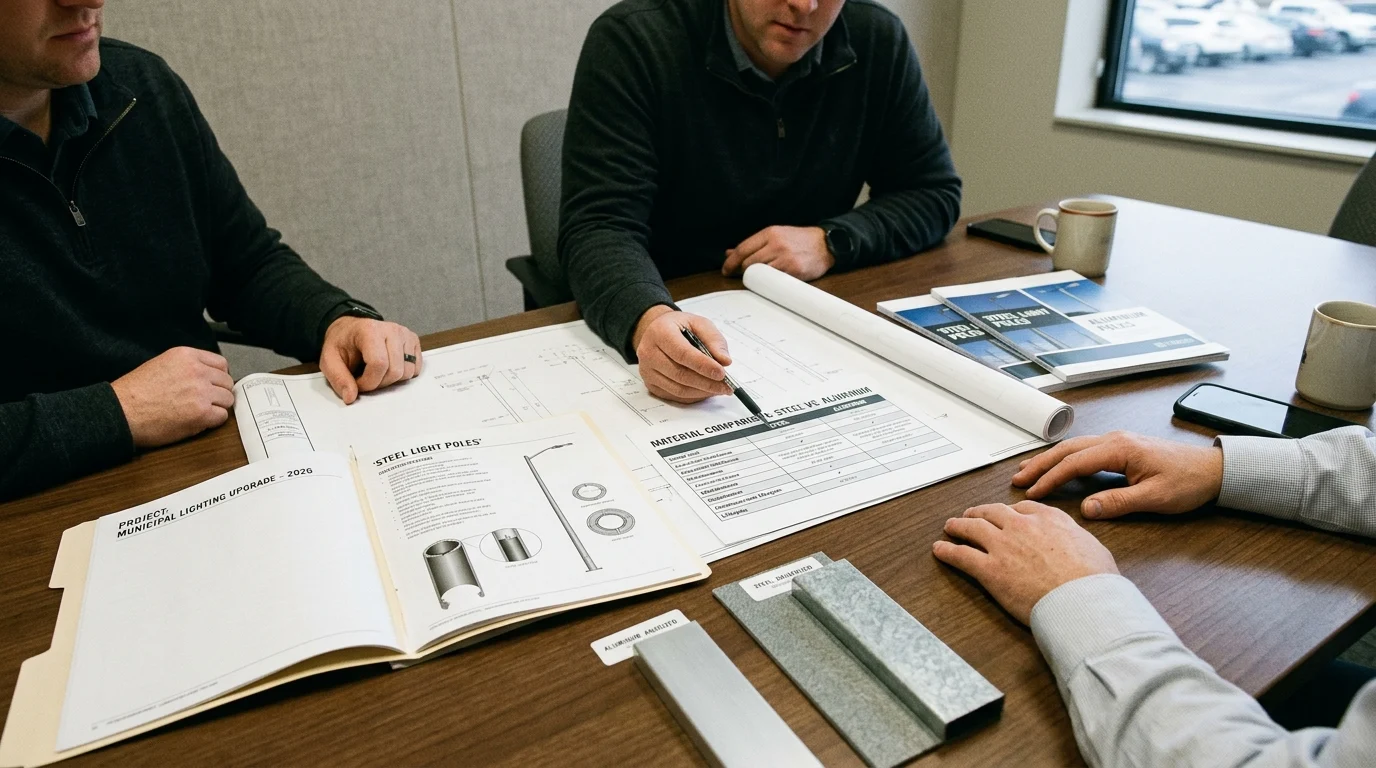
The ultimate decision between steel and aluminum light poles requires a holistic evaluation of the project's mechanical requirements, budget constraints, and geographical location. Specifiers must move beyond personal preference and rely on a data-driven framework to ensure the selected infrastructure delivers both immediate value and long-term reliability.
A decision framework for specifiers and contractors
A robust
Key Takeaways
- The most important conclusions and rationale for Steel Light Poles
- Specs, compliance, and risk checks worth validating before you commit
- Practical next steps and caveats readers can apply immediately
Frequently Asked Questions
When should I choose steel light poles over aluminum?
Choose steel for taller poles, high-wind sites, or heavier loads like 5G small cells, cameras, and large LED fixtures. It offers higher stiffness and load capacity at a lower upfront cost.
Are steel light poles cheaper than aluminum poles?
Usually yes. Steel poles often reduce initial CAPEX by about 30% to 40%, though you should also budget for coatings, inspections, and possible recoating over the service life.
Do steel light poles rust easily?
Unprotected steel can oxidize, but galvanizing or quality coating systems greatly improve durability. For coastal or salt-heavy locations, specify the right finish and maintenance schedule before ordering.
Why are steel poles preferred for high-mast lighting?
Steel handles high EPA, heavy luminaires, and strong wind loads with less deflection. That makes it the standard choice for highways, ports, and other installations above typical pedestrian-scale heights.
Can Moreluxpost help specify the right steel pole for my project?
Yes. Share pole height, fixture weight, arm length, wind speed, and site conditions, and Moreluxpost can help match a steel pole configuration suited to your application.