
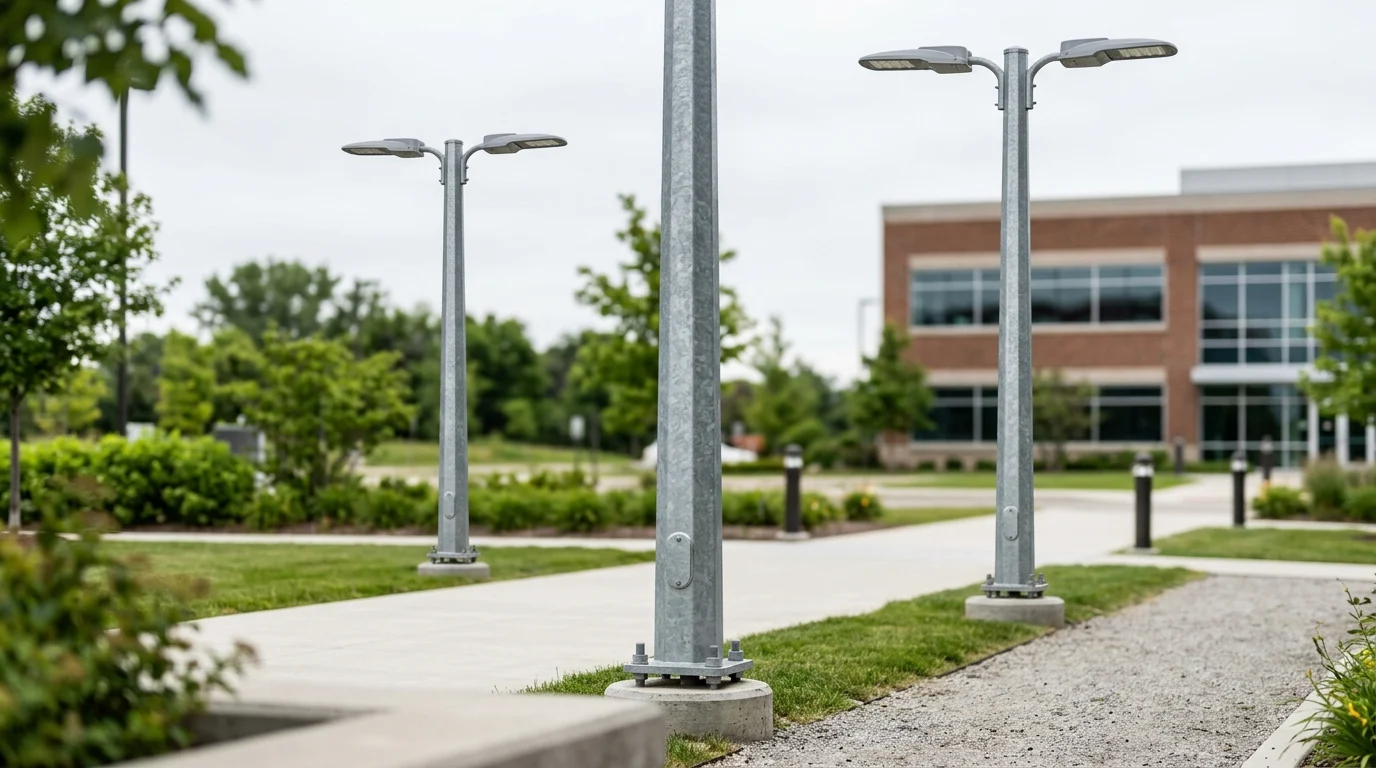
Why Galvanized Steel Light Poles Are a Strategic Choice
Procurement teams and urban planners consistently rely on galvanized steel light poles as the backbone of municipal and commercial lighting infrastructure. The fundamental advantage lies in the metallurgical bond formed during the hot-dip galvanizing process, which provides both barrier and cathodic protection against harsh environmental elements. For large-scale developments, selecting the right structural material is not merely an aesthetic decision but a highly strategic capital expenditure. Manufacturers with comprehensive in-house processing—spanning cutting, bending, welding, and coating—ensure that structural integrity aligns with long-term urban infrastructure goals.
How galvanized steel light poles reduce lifecycle cost
Evaluating the total cost of ownership (TCO) reveals why galvanized steel outperforms standard carbon steel alternatives. While the initial capital outlay for a hot-dip galvanized (HDG) pole may be 15% to 20% higher than a basic painted steel equivalent, the lifecycle financial metrics heavily favor galvanization. A properly specified HDG pole can achieve a maintenance-free service life exceeding 50 years in benign environments and 20 to 30 years in highly corrosive zones.
This durability eliminates the need for cyclical repainting and rust remediation, effectively reducing the TCO by 30% to 40% over a standard two-decade municipal planning horizon. By front-loading the investment into superior metallurgical protection, municipalities and developers bypass the recurring operational expenditures that drain infrastructure budgets.
Where corrosion risk has the greatest commercial impact
The commercial impact of corrosion extends far beyond the physical degradation of the asset. In coastal municipalities, industrial zones, and regions reliant on winter de-icing salts, structural failure due to internal or external rust poses severe liability risks. The hidden costs of premature pole failure include emergency replacement, complex traffic management, specialized labor, and potential collateral damage.
A single pole replacement in a high-traffic urban corridor can easily incur direct costs ranging from $2,000 to $5,000, dwarfing the initial unit price of the pole itself. Consequently, mitigating corrosion risk at the procurement stage is critical for protecting municipal budgets, ensuring continuous illumination, and maintaining rigorous public safety standards.
Corrosion Performance and Key Specifications
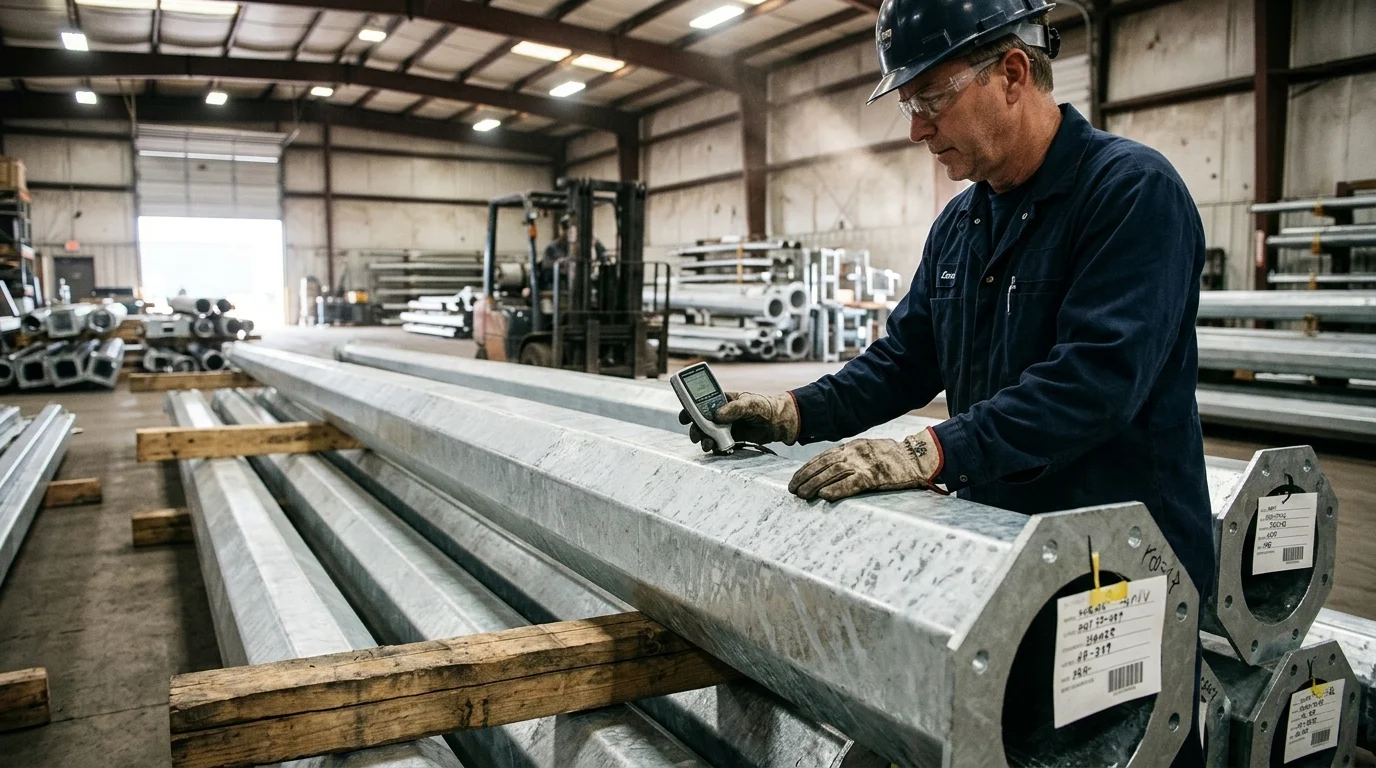
Specifying galvanized steel light poles requires a precise understanding of metallurgical standards and environmental variables. The effectiveness of the corrosion resistance is directly tied to stringent adherence to international galvanizing standards and the chemical composition of the base steel used during fabrication.
How galvanizing thickness and steel grade affect durability
The durability of a galvanized pole is governed by the steel grade and the resulting zinc coating thickness. High-quality urban infrastructure typically utilizes structural steel grades such as Q235 (yield strength 235 MPa) or Q345 (yield strength 345 MPa), equivalent to S275 and S355 in European standards. When these grades are subjected to hot-dip galvanizing according to ASTM A123 or EN ISO 1461, the minimum average coating thickness must typically reach 85 microns (approximately 3.4 mils) for steel thicker than 6mm.
The silicon and phosphorus content of the steel—specifically navigating the Sandelin curve—must be strictly controlled by the manufacturer to prevent excessively thick, brittle zinc layers that are prone to flaking during transportation or installation.
Which environmental conditions matter most in specification
Environmental classification dictates the required protective specifications. Procurement engineers utilize the ISO 9223 standard to categorize atmospheric corrosivity from C1 (very low) to C5-M (very high marine). In a C3 (medium) environment, the annual zinc depletion rate is relatively slow, averaging 0.7 to 2.1 microns per year. However, in a C5-M coastal environment, depletion can accelerate to 4.2 to 8.4 microns annually.
Understanding these atmospheric conditions allows buyers to specify the correct base galvanizing thickness or mandate dual-coating systems (galvanizing combined with powder coating) for extreme exposures.
| ISO 9223 Category | Environment Description | Expected Zinc Depletion Rate (µm/year) |
|---|---|---|
| C2 | Low (Rural, low pollution) | 0.1 – 0.7 |
| C3 | Medium (Urban, light industry) | 0.7 – 2.1 |
| C4 | High (Industrial, coastal) | 2.1 – 4.2 |
| C5-M | Very High (Marine, offshore) | 4.2 – 8.4 |
What technical specifications buyers should review
Buyers must review technical submittals meticulously before approving production. Key specifications include the base plate dimensions, anchor bolt circle (BCD) tolerances, and the welding standard applied prior to galvanizing (e.g., AWS D1.1). Because the galvanizing process involves dipping the pole into molten zinc at approximately 450°C (842°F), thermal stress can cause warping if the pole’s wall thickness is insufficient or if stress-relief techniques are ignored.
Procurement documents should explicitly state the acceptable tolerances for straightness—typically mandating no more than a 3mm deviation per meter of overall pole length to ensure perfect vertical alignment upon installation.
Comparison with Alternative Pole Materials
While galvanized steel is a dominant force in outdoor lighting infrastructure, procurement teams often evaluate it against alternative materials like extruded aluminum and standard painted carbon steel. The decision hinges on balancing initial expenditure, structural load capacity, and long-term maintenance obligations.
How galvanized steel compares with aluminum and painted steel
Comparing material performance requires analyzing structural and economic trade-offs. Aluminum poles offer excellent natural corrosion resistance through oxidation and are significantly lighter, which reduces installation labor. However, aluminum lacks the tensile strength of steel, making it less suitable for supporting heavy multi-luminaire arrays or large banners in high wind zones.
Standard painted steel, conversely, matches the strength of galvanized steel but relies entirely on a superficial barrier coating; once the paint is scratched, rapid under-film corrosion begins.
| Material | Initial Cost Index | Structural Strength | Maintenance Requirement | Lifespan in C3 Environment |
|---|---|---|---|---|
| Standard Painted Steel | 1.0x (Baseline) | High | High (Repaint every 5-7 years) | 10 – 15 Years |
| Galvanized Steel | 1.15x – 1.25x | High | Very Low | 40 – 50+ Years |
| Aluminum Alloy | 1.4x – 1.6x | Medium | Low | 40 – 50 Years |
When galvanized steel is the better commercial choice
Galvanized steel emerges as the superior commercial choice in scenarios requiring high Effective Projected Area (EPA) ratings and strict budget adherence. For highway interchanges, massive sports complex lighting, and high-mast applications exceeding 12 meters, the yield strength of steel is non-negotiable.
While aluminum requires a 40% to 60% higher initial capital outlay, galvanized steel achieves the necessary structural rigidity at a fraction of the cost. Furthermore, when municipalities demand aesthetic customization, galvanized poles can be powder-coated post-galvanizing. This duplex system extends the corrosion protection by a synergistic factor of 1.5 to 2.5 times the sum of the individual lifespans, creating an unbeatable commercial proposition for premium urban zones.
How to Source from Manufacturers
Sourcing galvanized steel light poles directly from manufacturers requires rigorous vetting of their production infrastructure and supply chain management. Partnering with factories that maintain comprehensive in-house processes minimizes quality control risks and ensures adherence to international export standards.
What factory capabilities and quality controls to verify
Evaluating factory capabilities begins with assessing their fabrication and galvanizing infrastructure. Top-tier manufacturers utilize CNC laser cutting, automated submerged arc welding, and heavy-duty tandem press brakes capable of forming tapered octagonal or conical poles up to 14 meters in a single continuous section.
Crucially, buyers must verify the dimensions of the factory’s galvanizing kettle. A kettle length of 12 to 14 meters ensures that large poles can be hot-dipped in a single pass, eliminating the structural weaknesses and uneven coating aesthetics associated with double-dipping. ISO 9001 certification should be a mandatory prerequisite to guarantee consistent quality management across the production floor.
How MOQ, customization, packaging, and documentation affect sour
cing
Commercial terms such as Minimum Order Quantity (MOQ), packaging, and logistics play a vital role in international sourcing. Due to the volumetric footprint of light poles, MOQs are typically structured around container capacities. A standard 40-foot High Cube (40HQ) container can accommodate approximately 50 to 80 units of 8-meter poles, depending on the base plate size and nesting capabilities.
Packaging is a critical vulnerability for galvanized products; improper wrapping can trap moisture during ocean transit, leading to zinc hydroxide formation, commonly known as ‘white rust.’ Buyers should mandate breathable packaging materials, such as felt wrapping or hessian cloth, and prohibit tightly sealed plastic wraps that prevent adequate airflow.
Which certifications, inspection standards, and contract terms m
atter
Risk mitigation in cross-border procurement relies heavily on strict certification and inspection protocols. Supply contracts should explicitly reference acceptable galvanizing standards (ASTM A123 or EN 1461) and require Mill Test Certificates (MTC) for the raw steel to verify the chemical composition.
For large-scale municipal projects, integrating third-party pre-shipment inspections (e.g., via SGS or TUV) into the contract ensures that coating thickness, weld penetration, and dimensional tolerances are verified before container loading. Standard payment terms typically involve a 30% telegraphic transfer (TT) advance, with the 70% balance contingent upon successful inspection and presentation of the Bill of Lading.
Procurement Decision Framework
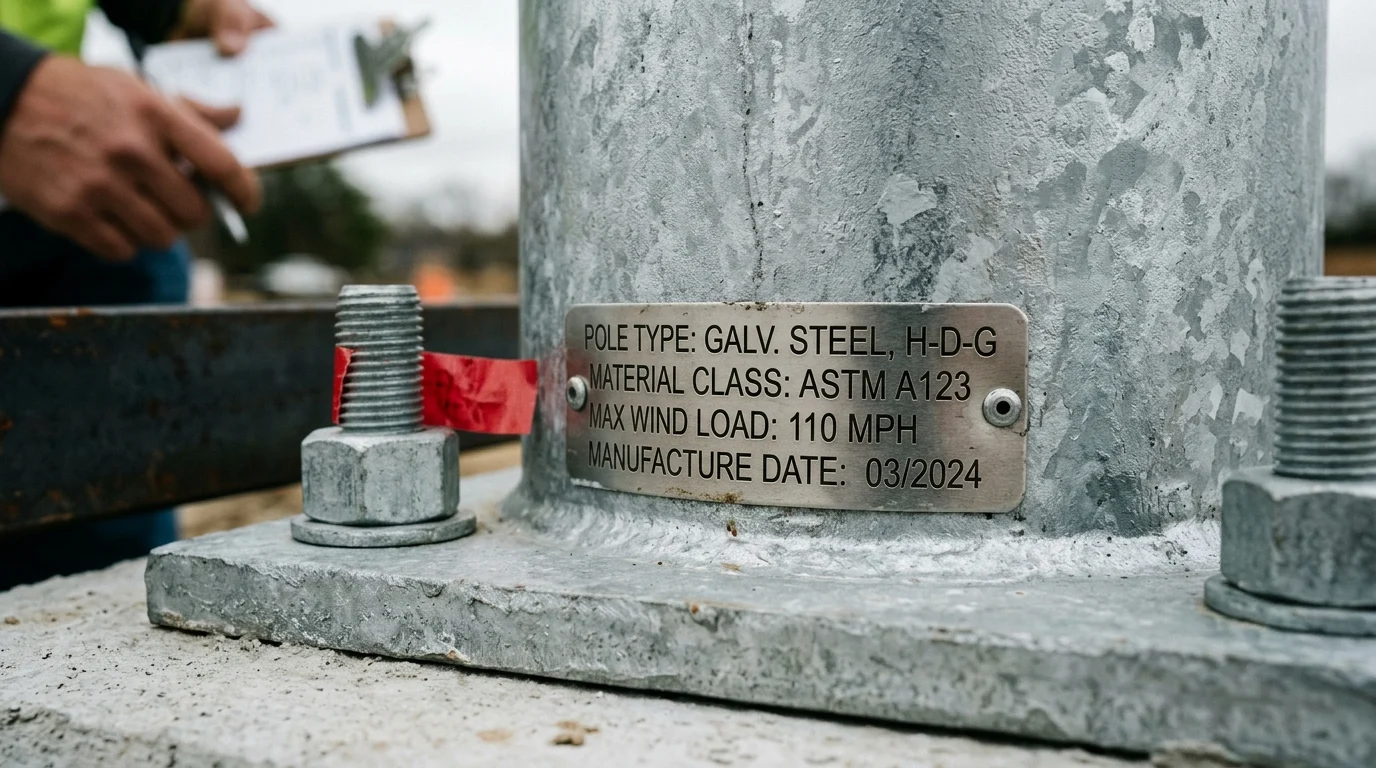
Executing a successful procurement strategy for galvanized steel lighting infrastructure demands a structured, data-driven decision framework. Cross-functional teams—comprising procurement officers, structural engineers, and municipal planners—must align their evaluation criteria to maximize long-term asset value.
What evaluation process teams should use
A robust evaluation process utilizes a weighted vendor scoring matrix to move beyond simple lowest-price comparisons. Best-in-class procurement teams typically allocate a 40% weight to technical compliance (steel grade, zinc thickness, welding standards), 30% to commercial terms (unit pricing, payment structures), and 30% to production capacity and lead times.
Given that standard manufacturing and galvanizing lead times range from 30 to 45 days, assessing a supplier’s historical on-time delivery performance is critical for preventing downstream construction delays. Teams should also audit the supplier’s raw material sourcing stability to forecast potential price volatility and ensure uninterrupted supply for multi-phase developments.
Which specification and sourcing choices improve project outcome
s
Project outcomes are significantly improved when specific design and sourcing refinements are integrated early in the RFQ phase. Mandating features such as tight-fitting top caps, elevated base plates, and internal anti-condensation coatings prevents internal moisture accumulation, which is a leading cause of unseen structural degradation.
Additionally, requiring suppliers to provide detailed structural calculations and wind-load simulations tailored to the specific installation site ensures regulatory compliance and long-term safety. By shifting the procurement focus from transactional purchasing to lifecycle asset management, buyers can secure highly durable, cost-effective urban lighting solutions that resist corrosion and serve communities for decades.
Key Takeaways
- Wholesale sourcing and supply-chain implications for Galvanized Steel Light Poles
- Specifications, compliance, and commercial terms buyers should validate
- Actionable recommendations for distributors and procurement teams
Frequently Asked Questions
Why are galvanized steel light poles better for corrosion resistance?
Hot-dip galvanizing creates a bonded zinc layer that shields steel and provides sacrificial protection, slowing rust far better than basic painted steel in municipal and commercial sites.
How long can a galvanized steel light pole last?
A properly specified HDG pole can last over 50 years in mild environments and around 20–30 years in coastal, industrial, or salt-exposed areas.
What standards should buyers check before ordering galvanized poles?
Review compliance with ASTM A123 or EN ISO 1461, steel grade such as Q235/Q345, and average zinc coating thickness, often around 85 microns for thicker steel sections.
When should a dual-coating system be specified?
Use galvanizing plus powder coating in aggressive environments like C4 or C5-M coastal and industrial zones, where higher zinc depletion rates can shorten service life.
Can Morelux customize galvanized steel light poles for city projects?
Yes. Morelux offers in-house cutting, bending, welding, coating, and testing, supporting tailored pole designs for municipalities, planners, and large-scale urban infrastructure projects.