
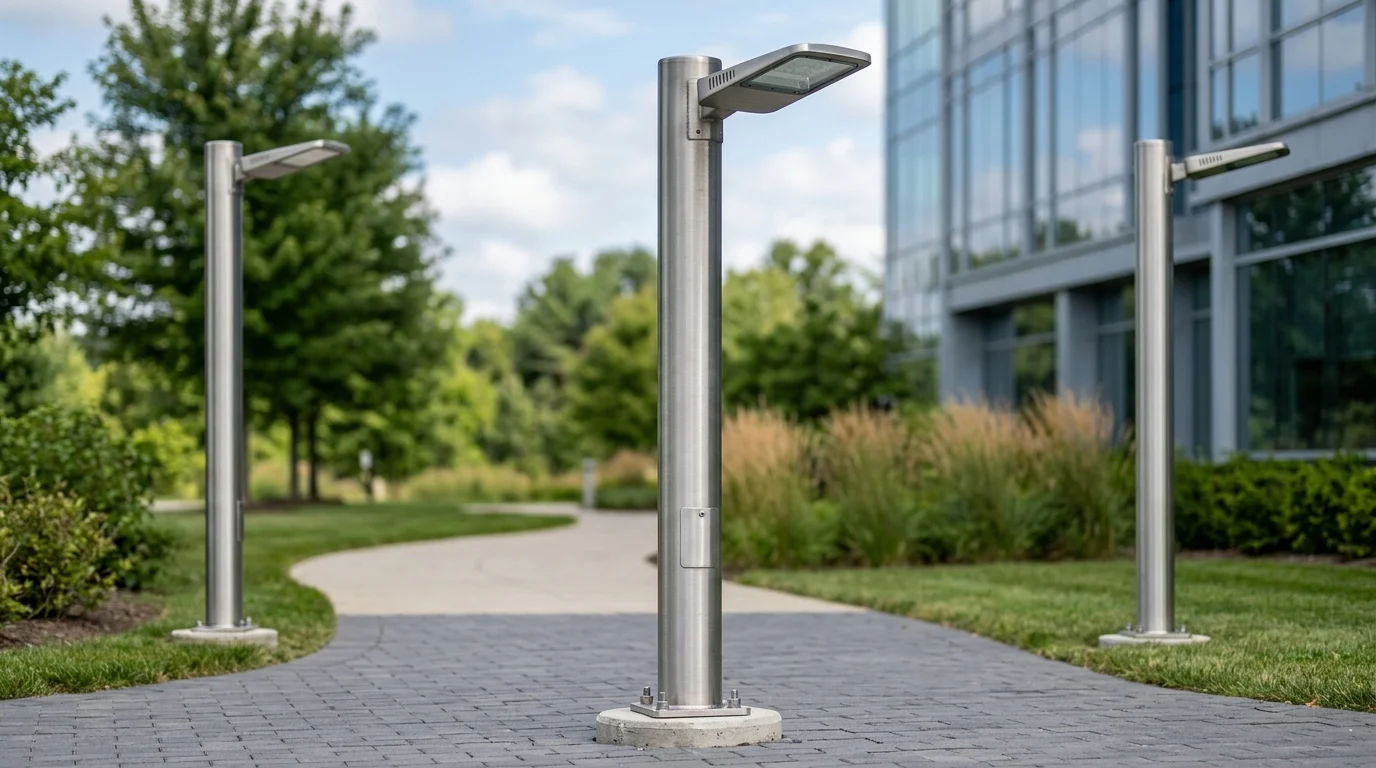
Introduction
Outdoor lighting poles must withstand weather, pollution, and years of continuous use without becoming a maintenance burden. Stainless steel stands out because it combines high structural strength, strong corrosion resistance, and a clean architectural finish that suits streets, commercial sites, campuses, and coastal areas. Although the upfront cost can be higher than some alternatives, its long service life often makes it a more economical choice over time. This article explains why stainless steel light poles perform so well in demanding environments, how they compare with other materials, and what practical benefits they offer for durability, appearance, and lifecycle value.
Why Choose Stainless Steel Light Poles
Stainless steel light poles have emerged as the premier structural choice for modern outdoor lighting networks, offering an unmatched combination of structural integrity and aesthetic appeal. While traditional materials frequently suffer from degradation in harsh environments, stainless steel provides a resilient foundation for urban streetscapes, high-end commercial properties, and coastal promenades.
The specification of outdoor lighting infrastructure requires balancing immediate project budgets with long-term asset durability. In this context, stainless steel stands out as an engineering material that mitigates environmental risks while elevating the architectural finish of a site.
Lifecycle Value and Long-Term Performance
The primary driver behind selecting stainless steel is its exceptional lifecycle value. While initial capital expenditures may be higher than those of alternative materials, these poles consistently deliver a functional lifespan exceeding 50 years under normal environmental conditions. This extreme longevity drastically reduces the frequency of capital replacement cycles and minimizes labor-intensive maintenance interventions, resulting in a highly favorable return on investment over a multi-decade operational period.
Corrosion Resistance and Appearance Benefits
The defining characteristic of stainless steel is its inherent corrosion resistance, derived from a minimum chromium content of 10.5%. This specific metallurgical composition forms a microscopic, self-healing passive oxide layer on the surface of the metal. Unlike applied protective coatings that can chip, peel, or scratch over time, this intrinsic protection ensures that the poles maintain their premium finish—ranging from a subdued brushed satin to a high-polish mirror finish—even when consistently exposed to industrial pollutants, high humidity, and urban exhaust.
Key Quality Factors for Stainless Steel Light Poles

Specifying the correct stainless steel light poles requires a rigorous evaluation of metallurgical properties and structural engineering parameters. Engineering teams must evaluate several critical factors to ensure the infrastructure meets both localized safety standards and project-specific demands.
Grades, Finishes, Wall Thickness, and Strength
The selection of the alloy grade dictates the pole’s environmental resilience. Grade 304 is the industry standard for inland urban environments, while Grade 316L, which contains 2.0% to 3.0% molybdenum, is mandatory for coastal regions or heavy industrial zones. Wall thickness is another critical specification, typically ranging from 11-gauge (approximately 3.0mm) for standard pedestrian lighting to 7-gauge (approximately 4.5mm) for high-mast highway applications.
| Grade | Chromium % | Molybdenum % | Best Application | Relative Cost Multiplier |
|---|---|---|---|---|
| 304 | 18% | 0% | Inland urban, commercial | 1.0x |
| 316L | 16% | 2.0% – 3.0% | Coastal, de-icing salt exposure | 1.3x – 1.5x |
Wind Load, Height, Base Plate, and Anchor Design
Structural design must account for dynamic environmental forces. Poles must be engineered to withstand specific wind loads, often requiring compliance with 120 mph to 150 mph maximum wind speed ratings based on the Effective Projected Area (EPA) of the attached luminaires. Heights vary significantly based on application, from 10 feet for decorative pathways to over 40 feet for roadway illumination. To prevent fatigue failure at the foundation connection, base plates are typically fabricated from heavy-duty 1-inch to 1.5-inch solid stainless steel and paired with high-strength anchor bolts.
Manufacturing, Testing, and Certification Requirements
Rigorous manufacturing and testing protocols guarantee structural reliability. Reputable fabricators adhere to ASTM A666 for sheet materials and utilize automated welding processes compliant with AWS D1.1 structural welding codes. Non-Destructive Testing (NDT), such as ultrasonic or dye penetrant inspection, is frequently employed to verify weld integrity. These stringent testing requirements ensure a minimal defect tolerance at critical stress concentration points, safeguarding against catastrophic structural failure.
Stainless Steel vs Galvanized Steel Light Poles
The decision between stainless steel and galvanized steel represents a classic trade-off between initial procurement budgets and long-term asset management strategies. Both materials are heavily prevalent in the outdoor lighting industry, but their performance profiles and lifecycle costs diverge significantly over time.
Performance, Maintenance, Appearance, and Total Cost
Galvanized steel is widely utilized primarily due to its lower upfront cost; however, stainless steel commands a premium that is typically 2 to 3 times higher at the point of purchase. Despite this initial disparity, galvanized poles require periodic maintenance, including repainting or recoating every 10 to 15 years to mitigate the onset of rust. When calculating the Total Cost of Ownership (TCO), the zero-maintenance profile of stainless steel often achieves cost parity within the first 15 to 20 years of deployment, after which it provides pure cost savings.
Corrosion Resistance and Durability Comparison
The durability mechanisms of the two materials differ fundamentally. Galvanized steel relies on a sacrificial zinc coating (typically 3 to 4 mils thick) that depletes over time through galvanic action and environmental exposure. Once the zinc is consumed or breached by physical impact, the underlying carbon steel corrodes rapidly. Conversely, stainless steel’s passive layer is uniform and self-repairing in the presence of ambient oxygen. In accelerated salt spray testing (ASTM B117), premium stainless steel routinely surpasses 5,000 hours without significant degradation, whereas standard galvanized coatings may exhibit red rust significantly earlier under identical severe conditions.
| Feature | Stainless Steel (316L) | Galvanized Carbon Steel | Maintenance Interval |
|---|---|---|---|
| Protection Mechanism | Intrinsic passive oxide layer | Applied sacrificial zinc coating | 0 years (Maintenance-Free) |
| Surface Vulnerability | Self-healing if scratched | Rusts rapidly if coating is breached | 10-15 years (Recoating/Painting) |
| Aesthetic Finish | Architectural brushed or polished | Industrial matte spangle or painted | N/A |
Sourcing, Compliance, and Installation Considerations
Successfully integrating stainless steel light poles into a project demands meticulous sourcing strategies and strict adherence to regulatory compliance. Buyers must navigate a complex landscape of fabricator capabilities, logistical constraints, and localized engineering codes.
Supplier Capability and Fabrication Standards
Evaluating supplier capability extends far beyond basic manufacturing output. Top-tier suppliers maintain ISO 9001 certification and possess advanced laser cutting and robotic welding infrastructure to ensure precise dimensional tolerances. For commercial procurement, Minimum Order Quantities (MOQs) typically range from 20 to 50 units, though custom architectural designs may necessitate specialized, lower-volume batch runs. Buyers should consistently mandate complete mill test reports (MTRs) to verify the exact alloy composition and material provenance prior to fabrication.
Codes, Environmental Conditions, and Site Risks
Environmental and regulatory codes dictate the structural baseline for any installation. In North America, standards such as AASHTO LTS-6 govern the design of structural supports for highway signs, luminaires, and traffic signals. Projects situated within 5 miles of a saltwater coast or in regions utilizing heavy winter de-icing chemicals face elevated site risks. In these aggressive environments, localized building codes often strictly mandate the use of Grade 316L stainless steel to prevent catastrophic structural failure caused by chloride-induced stress corrosion cracking.
Selection Process for Matching Poles to Projects
The final selection process requires precise alignment between the pole’s structural capacity and the chosen lighting fixture. Engineers must calculate the combined physical weight and the Effective Projected Area (EPA) of the luminaire, mounting brackets, and any accessory attachments, such as municipal banners or security cameras. Overloading a pole beyond its engineered EPA threshold exponentially increases the risk of harmonic vibration and metal fatigue, underscoring the necessity for conservative specification margins during the design phase.
Long-Term Procurement Guidance

For large-scale infrastructure and commercial developments, the procurement of outdoor lighting assets must be viewed through the lens of long-term utility and financial sustainability. Strategic procurement aligns capital expenditure with comprehensive asset management goals.
Balancing Upfront Price Against Maintenance Costs
Balancing the upfront price against deferred maintenance costs is the cornerstone of effective procurement. Financial models evaluating Net Present Value (NPV) over a standard 40-year municipal infrastructure horizon consistently demonstrate that stainless steel yields substantial long-term savings. By eliminating the necessity for multi-stage recoating projects—which incur heavy labor costs, traffic control expenses, and specialized equipment rentals—the higher initial capital outlay is fully amortized, maximizing budget efficiency over the installation’s lifetime.
Final Guidance for Owners, Contractors, and Engineers
Owners, contractors, and consulting engineers should adopt a unified, highly detailed specification strategy. Final procurement documentation must explicitly define the required alloy grade, exact wall thickness, surface finish standard (such as a #4 brushed finish), and specific wind load capacity. By demanding strict adherence to these tolerances and requiring a manufacturer defect rate guarantee of less than 1%, stakeholders can confidently ensure the deployment of a resilient, aesthetically superior lighting network equipped to perform flawlessly for decades.
Key Takeaways
- The most important conclusions and rationale for Stainless Steel Light Poles
- Specs, compliance, and risk checks worth validating before you commit
- Practical next steps and caveats readers can apply immediately
Frequently Asked Questions
Why are stainless steel light poles a good long-term investment?
They can last 50+ years in normal outdoor conditions, reducing replacement cycles, maintenance labor, and lifecycle cost for public and commercial projects.
Which stainless steel grade should I choose for outdoor light poles?
Use 304 for inland urban areas. Choose 316L for coastal sites, industrial zones, or roads exposed to de-icing salts.
How do stainless steel poles compare with galvanized steel poles?
Stainless steel costs more upfront but offers better corrosion resistance, lower maintenance, and a cleaner architectural finish over time.
What project details are needed to specify a stainless steel light pole?
Confirm pole height, luminaire EPA, wind speed rating, wall thickness, base plate size, and anchor bolt requirements before production.
Can Morelux customize stainless steel light poles for municipal or commercial projects?
Yes. Morelux supports tailored pole designs and controls cutting, welding, polishing, coating, and testing in-house for reliable project delivery.